Comment by Olaf Lorenz, Senior General Manager, Digital Transformation Division, Konica Minolta Business Solutions Europe

Rethinking digital transformation for future print… AI, smart factories, sustainability, Industry 5.0 – and above all, human experience. These forces are reshaping the print landscape at unprecedented speed. For the first time, there is broad recognition that digital print has moved firmly into the mainstream, powering innovation across a highly connected global economy.

The push towards more efficient workflows, combined with rapid advances in automation, continues to accelerate digital print adoption.

A new year with a focus on EU packaging mandates, global supply shifts, and rising consumer demand for sustainability, digital printing will in many cases directly compete with established analog print processes. Offset, in particular, will feel the pressure.

The exciting evolutions underway in industrial and commercial print are widespread and will help our customers realise their ambitions, but what other big touchpoints will impact 2026 and beyond?

Building on last year’s predictions – spanning AI, Industry 5.0, robotics/cobots, greater automation and sustainability – here are the key trends influencing consumer, brand, and customer thinking in the years ahead.

Trend 1: The Unstoppable March of Digital Production

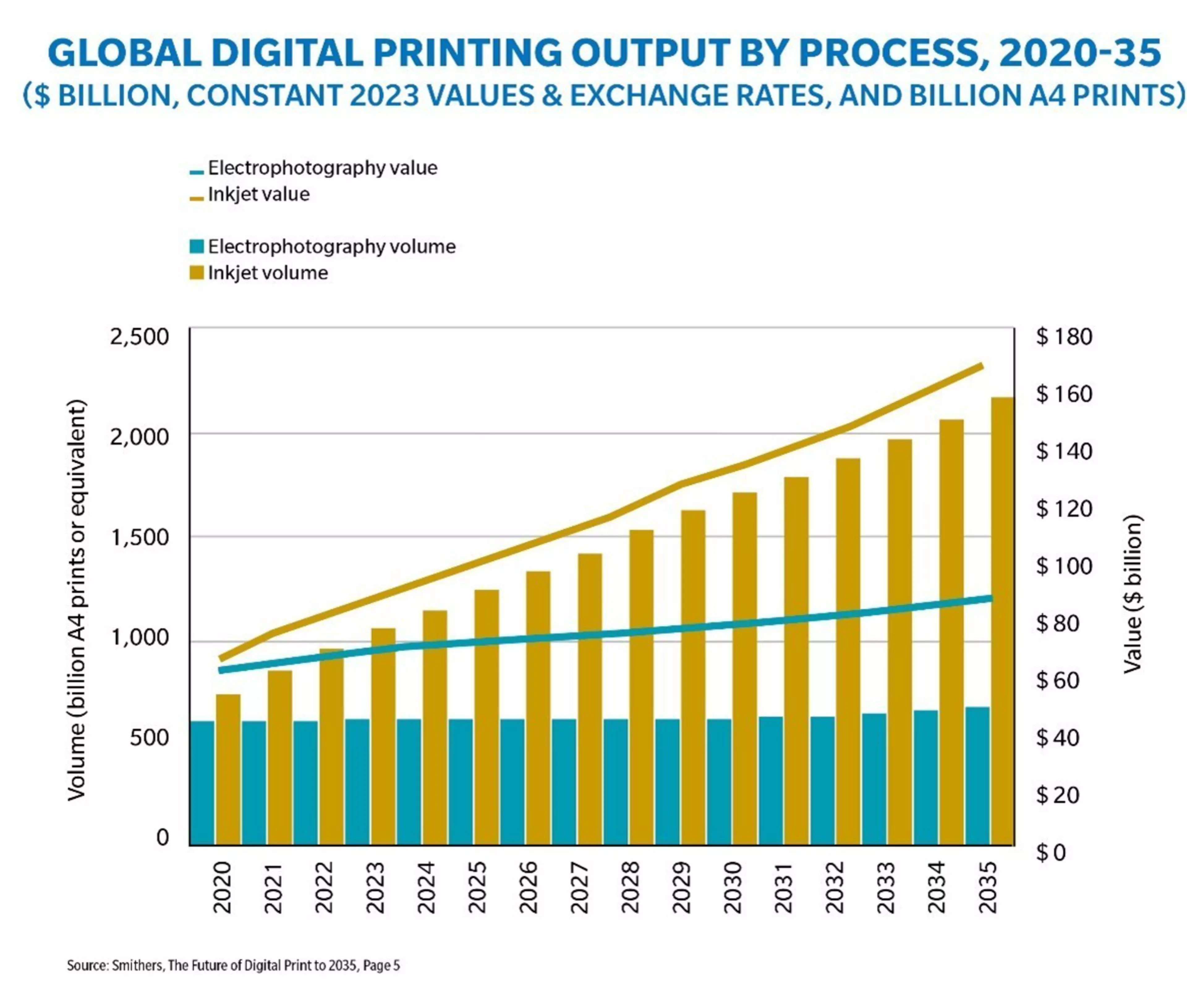
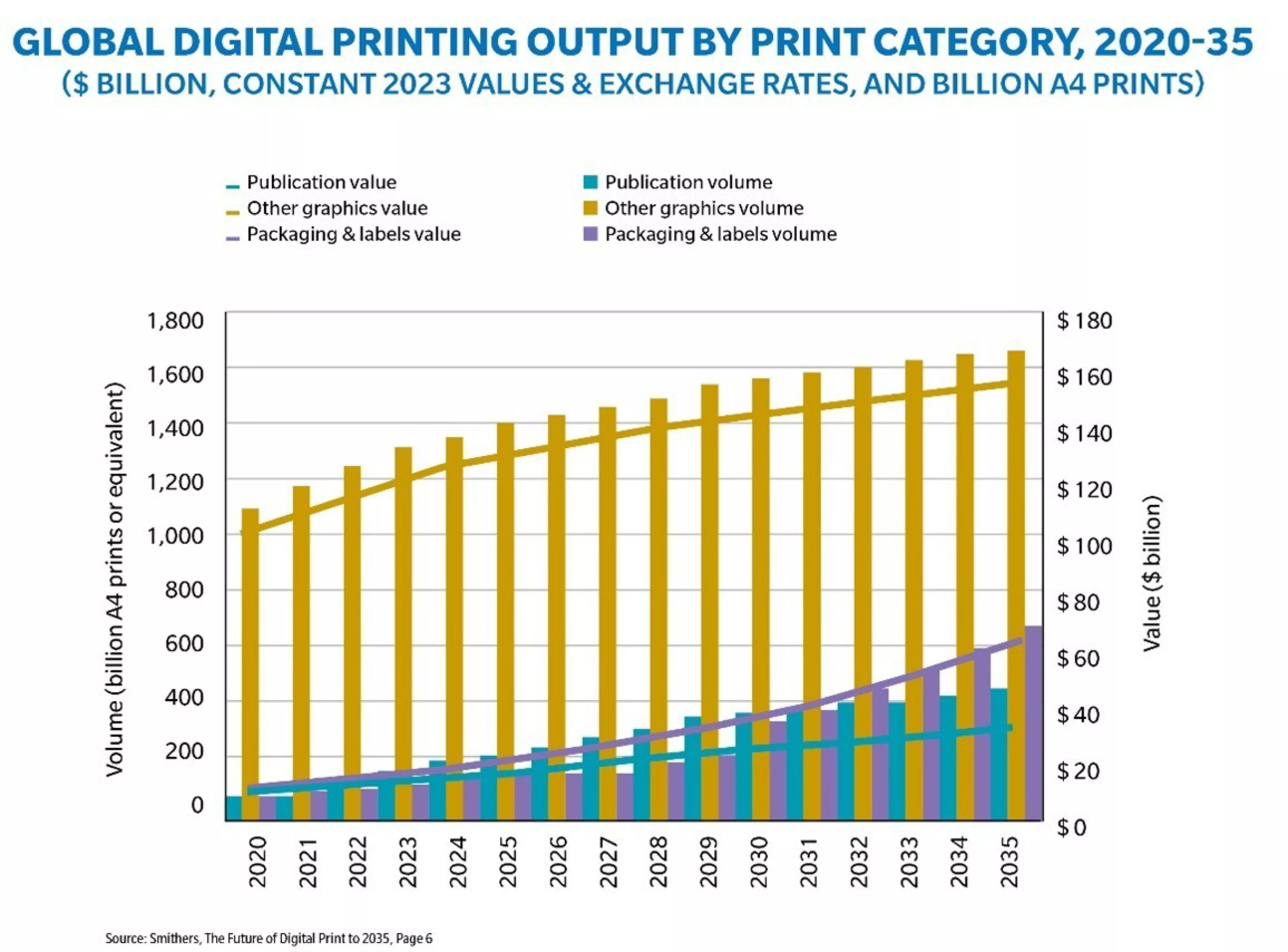
The most dynamic and fastest growing segment of a worldwide print market undergoing fundamental change – that’s digital printing! Technological advances are enabling new business models across multiple print segments, displacing legacy platforms and opening new commercial opportunities for print service providers.

A landmark study from research experts Smithers1 confirms the scale of the shift. Digital printing is now firmly established in books, mailings, display, security and labels with adoption in packaging, magazines and commercial print2.

According to Smithers, digital print will account for 22.5% of the global value of all print and printed packaging, increasing by almost 50% from $167.5 billion in 2025 to $251.1 billion in 2035. And whereas inkjet technology is increasing by the biggest volume and value, toner production is expected to grow at a compound annual growth rate (CAGR) of 1.9% in the same period to 2035.

Smithers, The Future of Digital Print to 2035, Page 5

Smithers, The Future of Digital Print to 2035, Page 6

Trend 2: Automated Approach to Combat Staff Shortages

Recruiting and retaining skilled staff remains a challenge across the print industry. As a result, investment in robotics and automation systems is accelerating, helping organisations maintain productivity and build long-term resilience. 

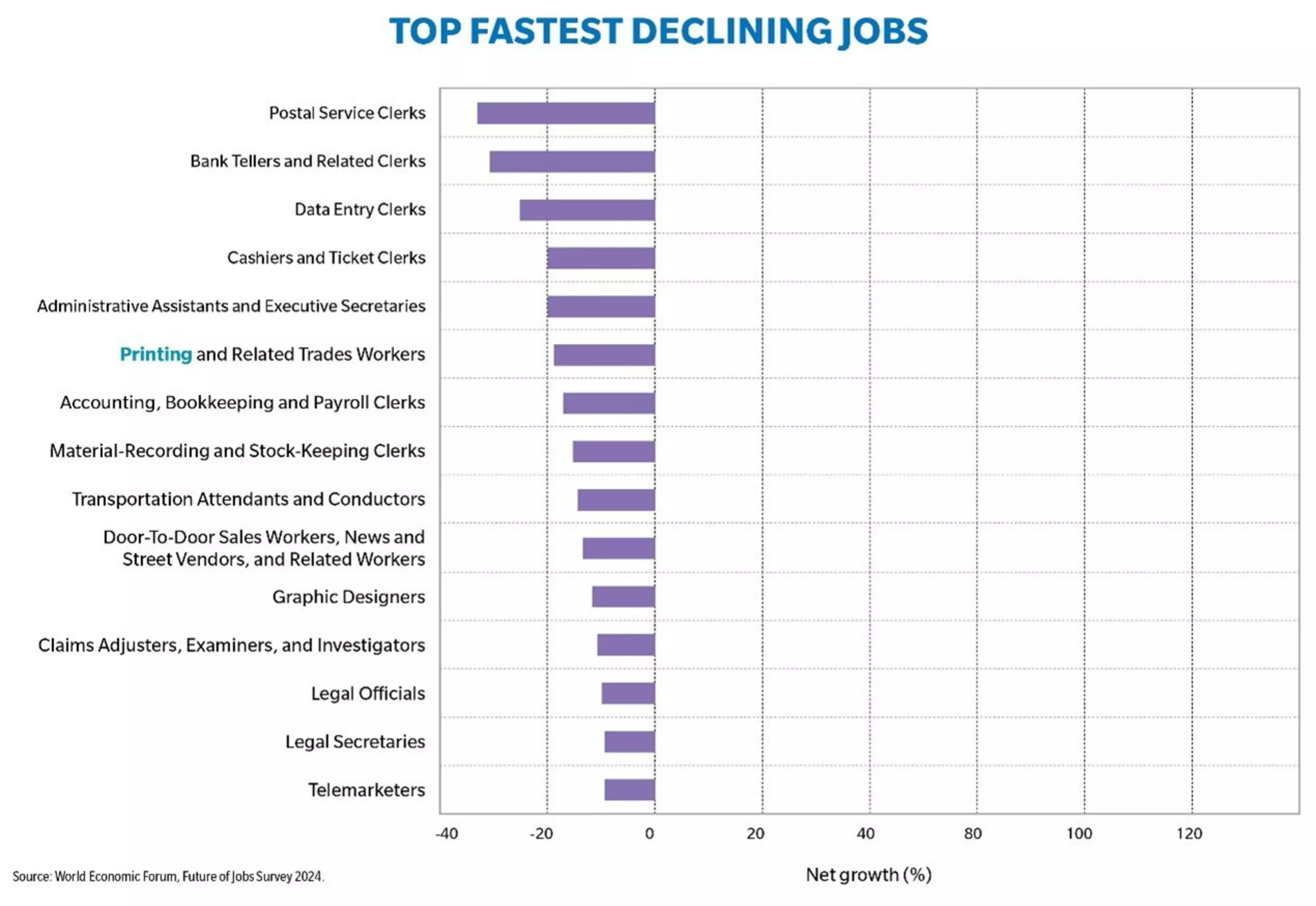
Experts from the World Economic Forum1 forecast some 2 million printing and related trade jobs will disappear in a five-year period to 2030, around 20% of the workforce. “Broadening digital access, AI and information processing technologies, and robots and autonomous systems are the primary drivers for this decline,” it states.

Trend 3: Technology that Eliminates Costly Reprints

In high-speed print environments, every second and every sheet counts. This is why the industry is prioritizing technologies that prevent errors, paper jams, and ensuring flawless output . with less intervention and highly reduced risk of costly reprints.

Our Intelligent Media Sensors answer these everyday problems:

  • The IM-104 uses six advanced sensors to instantly identify paper characteristics, eliminating manual adjustments and ensuring optimal settings.
  • The IM-105 adds even greater precision, measuring paper size and detecting subtle cutting variations – again, with minimal operator interventions.

These innovations help printers maintain consistency, reduce downtime and protect margins.

The Printing and Related Trades is amongst the top-fastest declining job sectors4

Trend 4: Predictive Intelligence Becomes the New Standard

Unplanned printer issues may become a thing of the past. Predictive maintenance (PdM) is rapidly evolving, and machine-learning algorithms are increasingly anticipating faults before they occur.

As a pioneer in PdM, we expect future systems to trigger maintenance autonomously, ensuring predictable, trouble-free operation.

More on the key advancements that make predictive maintenance even more effective can be found in this blog1 from consultants Sumnerone, which also spotlights developments from Konica Minolta in this area.

Trend 5: Virtual Service for Faster, More Efficient Recovery

Even with predictive maintenance, unexpected issues can still arise. With uptime more critical than ever, remote servicing is becoming a cornerstone of modern print operations.

Our Virtual Service Visit (VSV) program now supports hundreds of thousands of connected devices and has delivered an estimated 2.95 million additional uptime hours. From our own statistics, 28%6 of all issues are resolved without an engineer going on site – and the average remote fix takes just eight minutes7.

Recent examples show how transformative our award-winning remote service8 can be – including two customers who experienced issues late on a Friday. Both were diagnosed and fixed remotely the same afternoon, avoiding costly downtime and ensuring complete satisfaction.

Trend 6: Regulation-Driven Design Reshapes Packaging

2026 marks the full implementation of the EU Packaging and Packaging Waste Regulation (PPWR), effective since February 2025. This milestone requires brand owners, label converters, printers and packaging companies to rethink packaging and integrate design-for-recycling principles, source certified materials, and implement smart tracking systems to meet circulatory goals. It’s a crucial step forward towards the EU’s goal of making all packaging recyclable in an economically viable way by 2030.

Compliance will now demand proactive circularity. This will integrate recyclability, reuse, and transparency from the outset. Digital label production is well placed to support this shift, offering lower waste, efficient short runs, and traceability. Converters with certified materials, design-for-recycling capabilities, and smart tracking systems will be at the forefront of this transition.

Despite global uncertainty - from geopolitical tensions to fluctuating consumer demand – digital’s adaptability make it a stabilizing force for converters seeking agility and efficiency.

This regulatory shift also encourages printers to rethink traditional methods, embrace digital-first production, and explore value-adding embellishment technologies.

Looking Ahead - Shaping a Digital Future

As 2026 unfolds, printers face a market defined by transformation and opportunity. From digital printing and personalization to cloud-based ERP systems and automation, innovation will be key to competitiveness.

One thing is certain – and it’s not just our opinion: the analog-to-digital transformation will keep advancing into more valuable market niches.

As Smithers notes9, there will be a significant increase in digital printing over the next decade, stating: “...digital printing will fare much better than analog alternatives” because it better meets the needs of many brands, end users, and sustainability-driven markets.

The momentum of digital print is growing. Watch this space.

1Smithers, The Future of Digital Printing to 2035, Executive Summary, Page 8

2Smithers, The Future of Digital Printing to 2035, Executive Summary, Page 9

3World Economic Forum, Future of Employment Report, Page 19

4World Economic Forum, Future of Employment Report, Page 19

5Sumnerone, AI-Driven Predictive Maintenance: How Printing Technology Became Smarter

6Konica Minolta own service statistics, FY 2024

7Konica Minolta own AIRe Link, FY 2024 statistics

8BLI 2023-2024 Pacesetter Award in Remote Service

9Smithers, The Future of Digital Print to 2035, Page 18

Share:

Contact

Andrea Meyer
Andrea Meyer

Communications & Content Manager